Flat commute with one bridge ramp? How to choose between one, three and seven speeds
How to match gear count to the terrain you actually ride, and what a careful buyer checks before choosing a single speed, a three-speed hub or a seven-speed derailleur.
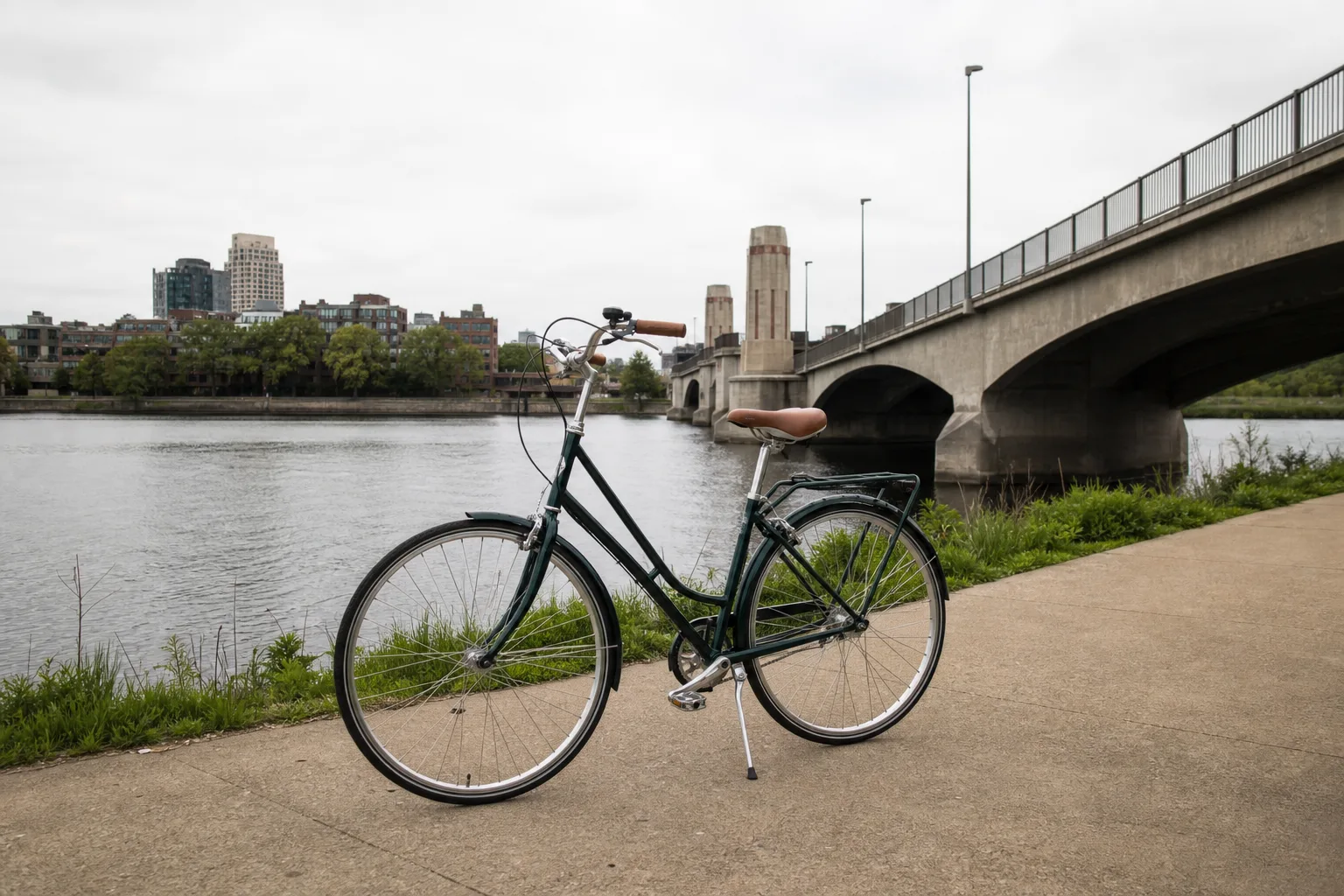
The question of how many speeds an upright bike needs is usually answered by the shop rather than the route, and the answer tends to be whatever the shop has in stock. A careful buyer reverses that order. Ride the trip you intend to make on the bike you already own, or walk it, and notice where the ground stops being level: a highway overpass, a levee ramp, a parking garage exit, the last two blocks home. Those few places, not the flat mile in between, decide the gearing.
Gear inches without the arithmetic
Gear inches is the standard way of describing how hard a given gear is to push, and the number combines chainring, cog and wheel size into one figure so that two very different bikes can be compared. The arithmetic is not the useful part. What matters is the ranking: a low number means the pedals turn easily and the bike moves slowly, a high number means the opposite. Most upright city bikes sold for flat riding sit in a middle band that feels comfortable at conversational speed on level pavement, which is exactly why they struggle the moment the pavement tips.
Single speed: honest, quiet, and narrower than it looks
A single speed has no shifter, no cable, no derailleur hanger to bend, and a chainline that stays straight, which is why the chain lasts and the drivetrain stays quiet. On genuinely flat ground with a rider who is not in a hurry, it is a complete answer. The limit is not steepness alone but sustained resistance of any kind, and a headwind across an open bridge deck applies the same load as a modest grade without the courtesy of ending. Riders who stand up and grind through those stretches usually accept the trade. Riders who arrive sweating usually do not.
Three-speed internal hubs: the traditional city answer
An internally geared rear hub puts the mechanism inside a sealed shell, so nothing hangs into the spokes, nothing collects road salt, and the bike can be shifted while stopped at a light. Three speeds typically give one gear below the flat-ground cruising gear, the cruising gear itself, and one above it. That low gear is the whole point: it covers a bridge ramp, a driveway apron, a loaded pannier and a headwind, which for most short-trip riders is the complete list of hard moments. Chain tension is fixed, so the chain rarely comes off, and a full chaincase becomes possible.
Service is where a careful reader slows down. An internal hub needs very little attention, but the attention it does need is specialized: a shift cable adjusted to a marked indicator, an oil change or grease service at long intervals, and, if something inside fails, a hub that goes to a shop willing to open it or back to a distributor. Many neighborhood shops handle the cable adjustment routinely and send the rest out. Ask before buying, not after, and ask specifically about the hub brand on the bike in front of you.
Seven-speed derailleurs: universal parts, universal help
A seven-speed rear derailleur with a single chainring gives a wider spread than a three-speed hub, costs less to buy, and can be adjusted by essentially any bike shop in the country, including the service counter at a big-box store. Parts are commodity items and inexpensive. The costs are exposure and habit: the derailleur hangs low where a curb or a fallen bike can bend it, the chain must be moving to shift, and the cable and pulleys collect grit that eventually needs cleaning. None of this is difficult, and a rider who learns to set the two limit screws and turn a barrel adjuster owns the problem permanently.
What to check before you decide
Check whether the low gear is actually low, by riding the bike up the worst thing on your route rather than around the parking lot. Check that the shifter is reachable without moving your hands off the grips, which matters more on an upright bar than on a drop bar. Check the rear wheel removal procedure, since an internal hub and a coaster brake both add steps when a tire goes flat. The Consumer Product Safety Commission is responsible for federal bicycle safety requirements, and a bike sold assembled should arrive with its shifting set up rather than left for you.
Terrain decides this, and terrain is knowable. Walk the route, count the tilts, and buy the smallest number of gears that covers them comfortably, because every gear you do not have is one that cannot go out of adjustment.
- 01
Gear inches as a ranking
Gear inches condenses chainring, cog and wheel size into one comparable number. A lower figure pedals easily at low speed, a higher figure pushes harder and faster, and that ordering is all most buyers need from it.
- 02
Headwind acts like a grade
A steady crosswind or headwind on an exposed bridge deck loads the legs much the way a modest incline does. The difference is that a hill ends and a wind often does not.
- 03
Why single speeds last
With no derailleur, no shift cable and a straight chainline, a single speed has very few parts that drift out of adjustment. Chains and cogs on these bikes typically wear slowly and quietly.